
Technical Articles and Application Notes
6G: From Vision to Silicon Reality
by Jyrki Penttinen, Alphacore, Tempe, Arizona.
6G standardization is rapidly moving from high-level vision to concrete requirements and early technical specifications. Along with such demanding, new performance and functional requirements, realizing these ambitions in practice will depend critically on the forthcoming advances of microelectronics
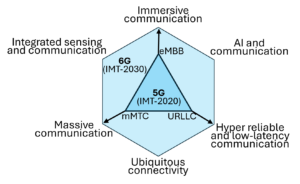
The key 6G usage scenarios as per ITU
Alphacore is helping translate future 6G requirements into practical, scalable silicon solutions. Among a variety of Intellectual Property (IP) solutions, Alphacore has designed best-in-class power consumption analog-to-digital converters (ADCs) and digital-to-analog converters (DACs) ranging from 8-12 bit resolutions. The current sampling rates of these solutions is up to 10 gigasamples per second, and Alphacore is extending the performance up to 64 gigasamples per second through ongoing research and development programs.
Through its participation in the Microelectronics Commons (ME Commons) SMART initiative, Alphacore is working on advanced mixed-signal and RF microelectronics that enable tightly integrated communication and sensing functionality within a single transceiver ASIC.
Design Feasibility and Link Budget Assessment of Aerial 5G IoT and eMBB Connectivity
by Jyrki Penttinen, Alphacore, Tempe, Arizona.
Uncrewed Aerial Vehicles (UAVs) equipped with radios can establish rapid, ad-hoc connectivity in areas where terrestrial infrastructure is unavailable or compromised. Leveraging the virtualized architecture of Fifth Generation (5G) mobile networks, both base station and required minimal core functions can be hosted aloft, enabling agile IoT or eMBB centric private networks for emergency response, expeditionary, military operations, and consumer events. This study evaluates the technical feasibility of UAV-mounted 5G Non-Public Network assembled from commercial off-the-shelf components, comparing the physical radio layer performance of IoT and evolved mobile broadband use cases. Candidate 3GPP architectural options are reviewed, and radio link budget calculations quantify physical layer performance in open and rural environments for a single UAV. The obtained results highlight the trade-off between frequency band, UAV-altitude, and the resulting radio coverage and data rate, providing design guidance for lightweight, energy efficient aerial 5G systems.
Transitioning Voltage Regulator Design From Unidirectional To Bidirectional
by Nazzareno (Reno) Rossetti, Alphacore, Tempe, Arizona.
Energy management systems (EMSs) are an emerging set of applications aimed at optimizing the energy flow and storage between electric vehicles, photovoltaic systems, home storage batteries and the electric grid. Such flexible energy management requires that fundamental blocks like voltage regulators and chargers, connected to the EMSs, operate bidirectionally with respect to the energy flow.
However, the vast majority of today’s blocks power traditional unidirectional loads like CPUs, motherboards, stationary and mobile devices. In these applications, the current and the associated energy flows unidirectionally from an input voltage source, which can have a wide range of operation, to a tightly regulated output powering a passive load.
Ruggedizing Buck Converters For Space And Other High Radiation Environments
by Nazzareno (Reno) Rossetti, Alphacore, Tempe, Arizona.
Space missions, riding on a wave of exciting new government and private initiatives, are multiplying and capturing the imagination of entrepreneurs as well as the public at large (Fig. 1). Every space device, from a spacesuit to a satellite, is a complex system not unlike other modern electronic appliances, needing microprocessors for computing power, sensors, energy to operate, energy storage to function untethered, and power management to minimize energy waste and extend operation on battery. However, in contrast with common electronics, space devices operate in a uniquely unforgiving environment, exposed to high radiation bombardment, which if not neutralized or mitigated, interferes with the electronics down to the level of a single transistor, causing disruption or even catastrophic failure.
Although space and commercial systems have a lot of electronics in common, space technology cannot draw directly from the wealth of electronics produced with great economies of scale by the commercial industry. Any off-the-shelf component utilized in a space application will likely degrade and fail prematurely once exposed to the severity of the space environment, endangering the mission. But not all is lost, as a wealth of ruggedization techniques are able to meet the challenges of this unforgiving environment.
In this article, we review first the effect of radiation on passive and active electronic components and the technologies, processes and device techniques that make them radiation-tolerant or radiation-hard. Subsequently we discuss Alphacore’s design of a radiation-hardened dc-dc converter at the heart of a space power management and distribution system. Able to properly function at up to 200 Mrad of TID, the converter can operate within the large hadron collider at CERN, and in space satellite and probe missions.